Building the Backyard Fiber Network
Back in 2017, I had an itch. After years of living in the suburbs, I wanted to find a quiet place in the woods where I could spread out a bit. My partner and I spent months searching, and on January 31, 2018, we closed on 6 acres of forest land near the top of a mountain outside Washougal, Washington. No utilities. No house. Just trees, deer, and the sound of wind through Douglas firs.
There was one small problem: my entire life revolves around the Internet. I run a telecommunications company. I work with data centers, VoIP systems, and network infrastructure every single day. Living somewhere without reliable connectivity wasn't going to work.

The Problem Nobody Wanted to Solve
I started talking to my future neighbors. The more I heard, the worse it got. Everyone on the mountain had a miserable experience getting online. DSL that barely worked. A local wireless ISP that couldn't penetrate the trees. Satellite with latency so bad you couldn't video call. Some folks were burning through expensive cellular data plans just to check email.
I sent out a survey to the local homeowners association. Every single respondent said their Internet experience was poor. The "best" connectivity anyone could get was marketed as 5-6 Mbps, but in reality most people were consistently getting less than 1 Mbps. For context, that's about what dial-up felt like in the late 90s.
Near the end of the survey, I asked a simple question: "If there was a better option, would you switch?"
100% said yes.
Calling the Big Guys
Since NocTel works with numerous national ISP's on other projects, I figured I'd reach out and see if they had any interest. Maybe I could help facilitate getting infrastructure to our neighborhood.
The answer was a polite but firm "no." Both companies ran the numbers: over 3 miles of mostly underground construction, roughly $800,000 in costs. They'd never see that money back from a neighborhood our size. Not in 10 years. Probably not ever.
I understood the math. I didn't like it, but I understood it.
So I decided to do it myself. How hard could it be?
Designing the Backhaul
The first challenge was getting bandwidth to the top of the mountain. The nearest fiber was at least 3 miles away, and running it underground would be prohibitively expensive for me too. But here's the thing about being on top of a mountain: you can see a long way.
I started scanning the horizon with a scope during good weather, mapping out what was visible from various spots on my property. Downtown Portland. Sylvan Hill. The Skyline towers. Portland Airport to the south. Nearly all the way to Scappoose on the north side. I had options.
My plan was to use microwave backhaul equipment to bring commercial-grade bandwidth from somewhere in the valley where fiber was already available. The equipment I had on hand could handle up to about 8 miles, so I drew a radius on Google Earth and started hunting for locations within that range.
Many weeks of driving around Washougal, Camas, and Vancouver followed. I even checked the view from Skyline and downtown Portland to see what might be possible with different gear. Finding the right spot isn't just about line-of-sight, you need someone willing to let you put dishes on their property, provide power, and ideally have fiber available nearby.
Finding the Sweet Spot
After months of searching, evaluating locations, and talking with property owners, I finally found someone willing to make a deal. The agreement let me put up a tower, gave me access to power, and allowed me to install fiber to an indoor equipment rack.
There was just one catch: the path ended up being 9.6 miles, which was outside the range of my existing equipment.
Time to go shopping.
The Moment of Truth
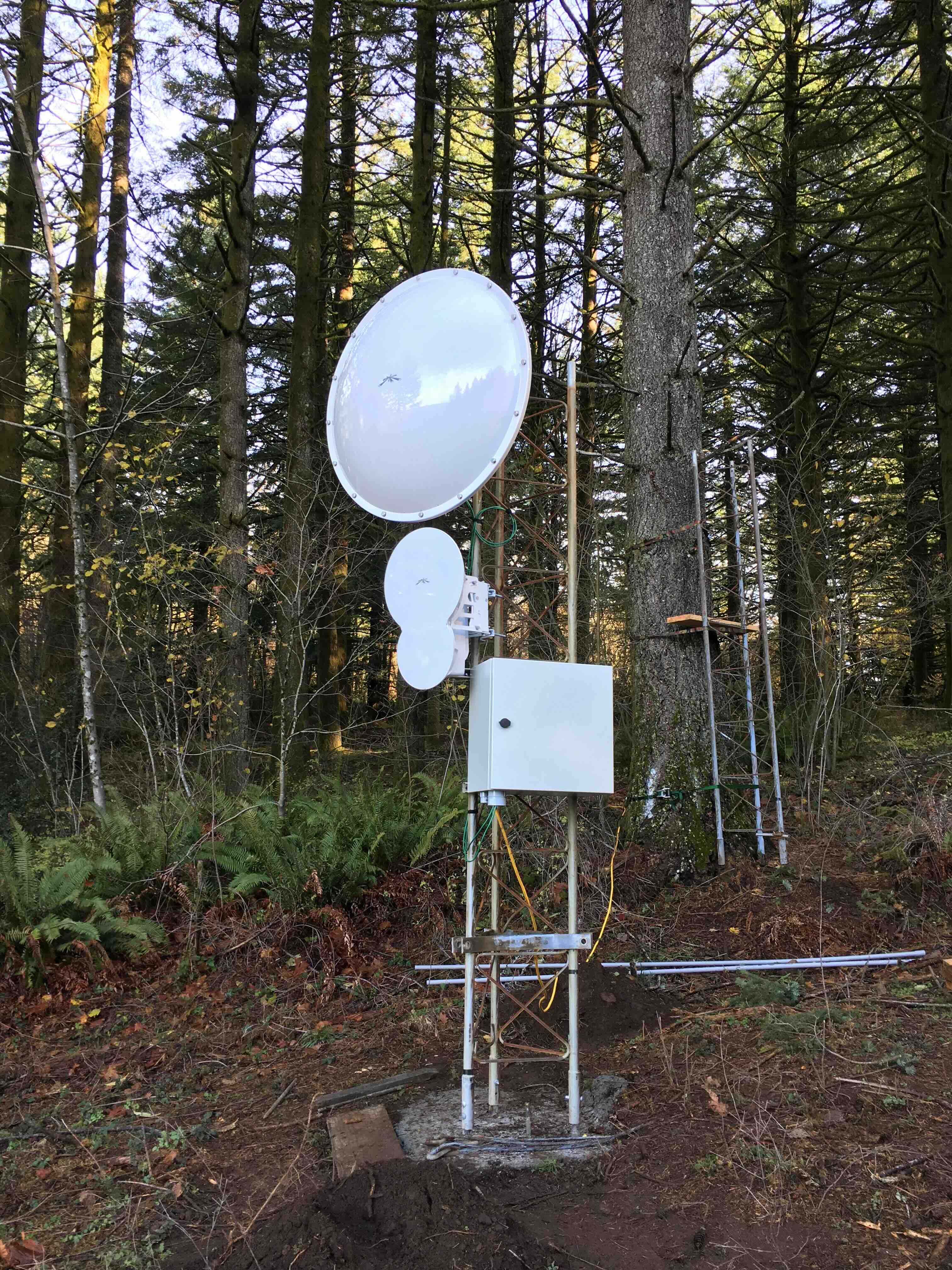
The tower pad was poured. The tower was set. An electrician ran a 20-amp circuit 900 feet from the breaker panel to the tower location. Cables were routed down into the building. Dishes were mounted and aimed.
This was it, months of work searching for the "right spot" were about to be validated or completely wasted.
The link came up.

Lesson Learned
The "1.2 Gbps" promise of the 5XHD ended up delivering about 400 Mbps real throughput at 9.6 miles. Here's something that isn't obvious if you're new to this: marketed bandwidth is transmit and receive added together. At best, we'd ever get 600 Mbps out of this gear. Still very reasonable for a neighborhood network, but I knew I'd need to find a better solution as bandwidth utilization increased.
Building the Infrastructure
So now I had a wireless link bringing bandwidth to a piece of property with no house. The next step was getting actual Internet service ordered and figuring out how to distribute connectivity around the neighborhood.
Ordering Bandwidth
The location I'd found for the uplink had multiple providers nearby, Comcast, CenturyLink, and Wave Broadband were all within 100 feet of the building. Since we already use Wave in several other locations, I ordered a 1 Gbps commercial fiber connection from them.
We set up full BGP peering like we do in our data centers. This gives us the ability to have multiple ISPs and multiple router/uplink locations in the future. It also let us use a block of our existing IP address inventory.
I ordered the circuit in early December 2018. They gave me an install date of April 2019, four months out.
I laughed at them for taking that long to install fiber that was only 100 feet away. But here's a little foreshadowing: I had no idea about all the permit processes I was about to learn. At least it gave me a deadline for when I expected to have service available for neighbors.
The Distribution Problem
Getting bandwidth to the mountain was one thing. Getting it to 48 individual properties spread across 5+ miles of road was something else entirely.
WiFi was out, we're in the middle of a forest and the trees would kill any signal. All the existing utilities (just power and phone) were underground, so there were no telephone poles to hang lines on. The only feasible option was to install fiber underground to each household.
Getting Permission
A little research revealed that the roads throughout the neighborhood were private and collaboratively owned by the community. No public right-of-ways. There was a 60-foot easement throughout the community for ingress/egress and utilities, created when power was installed back in 1980.
I reached out to the county and Clark PUD for more details. Since we're not a public utility, we didn't qualify to share the existing utility easement. They advised us to create individual agreements with each property owner.
So that's what we did. We drafted an agreement that gave us the ability to install and maintain conduits along the roadway and up to each residence. We went door to door, explained what we were trying to do, and got signatures.
Every single property owner signed.
Installing Fiber
Fiber is something I use every day in our data centers. When you need to hook something up, you measure how long you need, order the right jumper, clean the connectors, and plug it in. Pretty simple, right?
Well, come to find out, outside plant fiber is a completely different animal.
Learning from the Experts
I had a complete bill of materials designed and was ready to click "order." My plan was to buy direct burial fiber with pre-terminated connectors, drop it in a trench, and cover it up. Plug and play.
I grabbed lunch with my friend Matt Updenkelder, a VP at what's now Astound, who's been building fiber networks for decades. Matt taught me how to splice fiber and has been a mentor ever since, always available when I can't figure something out. I walked him through my design, expecting validation. Instead, he asked a question that would save the entire project: "What happens when the fiber gets damaged?"
I figured if it was underground, that wouldn't really happen.
I was very, very wrong.
"Three feet?!"
Matt apparently didn't realize this was a mountain. Made of rock.
The Equipment Hunt
I started doing the math. We're talking over 5 miles of road, not including all the drops to individual houses. This wasn't something a pick axe or even a walk-behind trencher could handle in any reasonable timeframe.
I started searching for equipment that could solve the problem. Finally found one on eBay in Redding, California, a 1999 Vermeer V3550 with 1,300 hours. Perfect for what we needed.
Just one problem: it was 11 feet long and 5,000 pounds. Wouldn't fit in my truck bed, and according to the rental places, wouldn't fit on a normal car dolly either.
I'd been meaning to get a dump trailer anyway. Apparently now was the time.
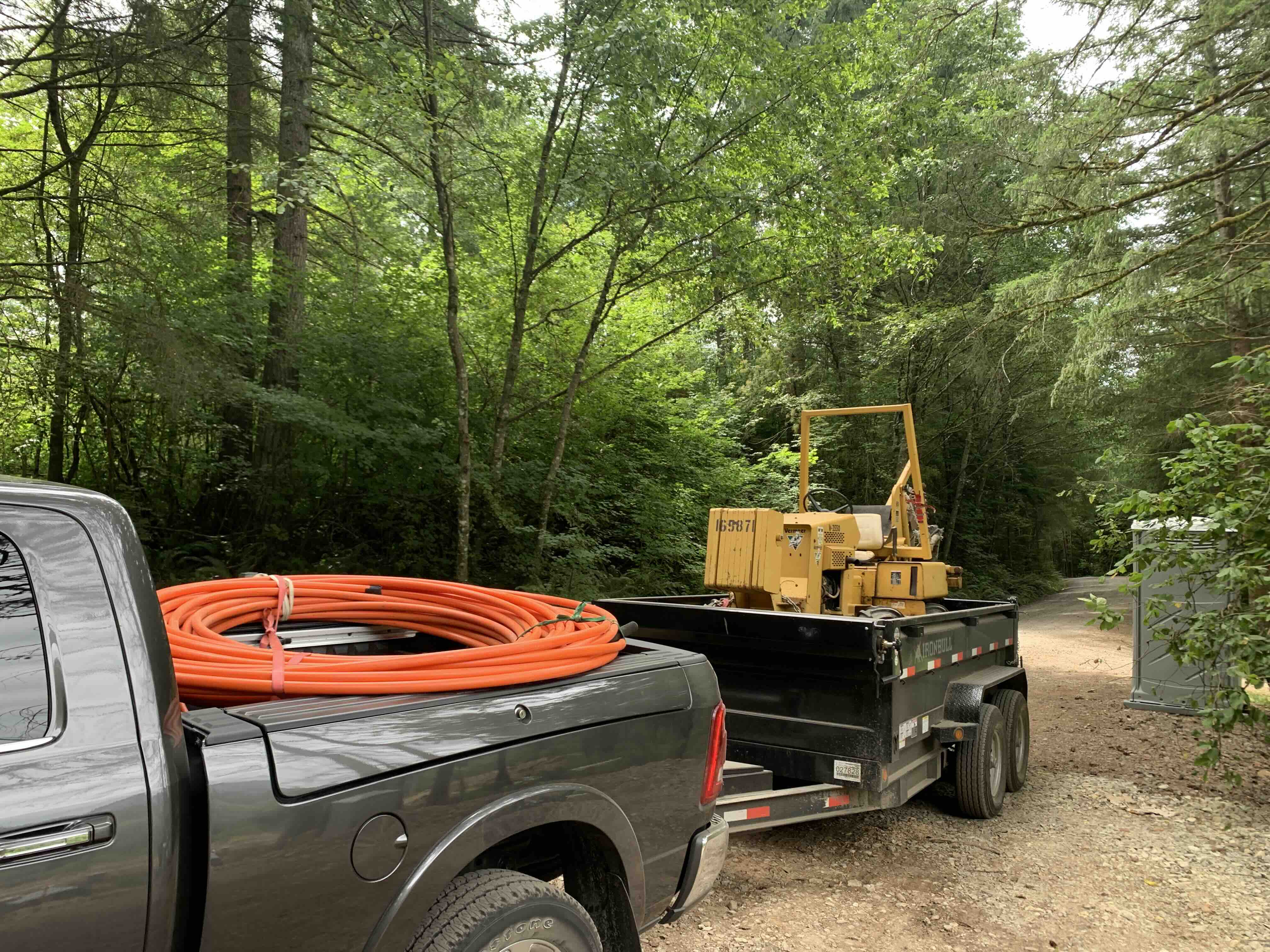
A few days before Christmas, I bought the trailer, drove to Redding, picked up the trencher, and hauled it back to its new home in Washington.
Breaking Ground
I ordered a roll of 1-inch ID conduit for the distribution backbone and 1/2-inch conduit for the house drops. Matt also talked me out of above-ground pedestals and into completely underground vaults, cleaner installation and less maintenance.
The weather turned unseasonably nice, and we started digging. A group of neighbors showed up to help, they wanted good Internet and they wanted it now. Within the first couple weeks, we had thousands of feet of trench opened up, conduit laid, and a half-dozen vaults installed.
Once we got the hang of the trenching equipment and developed a process for cutting across driveways and dealing with the inevitable mud (this was January in the Pacific Northwest, after all), we could install around 1,000 feet on a good day.
Pushing Fiber
After we had a number of conduits in the ground, we started pushing fiber through them. The 1/2-inch ID conduit for house drops turned out to be trickier than expected, a bit tight for pushing long distances.
Luckily, I'd ordered extra conduit couplers. We learned that if we pushed as far as we could, we could cut the conduit at a mid-span point, pull through to there, then push the rest of the way to the house. Depending on how many corners were in the conduit, we could typically get 200-300 feet per push.
Some houses were nearly 1,000 feet from the road. Those took a bit more effort.


The Core Network
With physical pathways in the ground, it was time to build out the network core. But here's the thing: there was no building on the property yet. I needed a way to house active equipment outdoors.
I found a locking, heated, and cooled outdoor rack from DDB Unlimited that would work. We installed conduits from the rack location to an adjacent vault and poured a concrete pad for it to sit on.
Once power was pulled into the rack, I could start building the network. We use Juniper switching, routing, and firewalls for all of our other projects and data centers, so this was no different:
- A pair of Juniper EX4300 switches in an 80 Gbps Virtual Chassis as the layer-3 core
- Dual 10 Gbps links in an LACP LAG feeding a Ubiquiti UFiber OLT for customer connections
- A pair of 1 Gbps links in an LACP LAG to the tower switch for the wireless backhaul
This gave us 2 Gbps of throughput capacity to the OLT, way more than we'd need for a while, but I've learned it's better to overbuild infrastructure than to be constantly upgrading.

Going Live
Wave was amazing. They turned up the circuit months ahead of the original April schedule (I'm sure it had nothing to do with my near daily request for a status report...). We finalized splices for the closest neighbors and brought the network online the next day.
Less than three weeks after opening the first trench, we had customers online with gigabit fiber.
Growing Pains
Getting the initial network running was just the beginning. Running an actual ISP, even a small neighborhood one, comes with its own set of challenges.
Upgrading the Backhaul
The Ubiquiti AF5XHD had served us well, but I knew we'd eventually need more capacity. I started researching better microwave equipment and landed on Siklu, they make enterprise-grade millimeter wave radios that can push serious bandwidth.
Buying the Siklu was a significant investment, but it opened up the possibility of true gigabit backhaul.
The Damaged Siklu Incident
We invested in Siklu millimeter wave radios for true gigabit backhaul. Then a contractor installing a new sign at our uplink site ran into our dish on the tower. Luckily we had upgraded to Mimosa B5C backup radios with 4' dishes, providing more throughput than the 5XHD ever could. We had our new backup link running. Luckily the contractor that hit our equipment pay for replacing the damaged gear. Sometimes security cameras pay for themselves in unexpected ways.
Lesson Learned
Always have a backup plan for your backup plan. We kept the Mimosa radios ready to go. They proved more reliable than the Ubiquiti 5XHD we'd started with, offering better modulation schemes and more robust performance. At 9.6 miles with rain fade, having multiple failover paths meant we could keep customers online while sorting out problems.
The Disasters (and How We Survived Them)
Building a fiber network teaches you humility. Here are some of the moments that reminded us just how creative rural infrastructure can get:
The Forgotten Springs Incident
Our 18,000-pound RTX750 rockwheel trencher was working its way through what looked like normal ground when it suddenly sank three feet deep into what turned out to be a hidden underground stream. The area on the map was called "Forgotten Springs." Apparently someone else had discovered this the hard way before us.

The Tree, the Chainsaws, and the Deer
On Mt. Norway, we'd installed a line the year prior. At one point, there was a mass of utility crossings and we only had trenchers at the time, so we went shallower than we should have. That's where the tree fell.
A massive tree came down during a windstorm. That part was fine. But the helpful neighbors with chainsaws who came to cut it up? One of them bucked a round just a little too deep, cutting right through our main distribution fiber.
I got the alarm at the office and drove out immediately. When I came around the corner, I found six guys standing around the cut-up tree, chainsaws on the ground, drinking beers. I pulled up and said, "Internet's down... what happened here?" They all laughed. Then they realized what they'd done.
They put down their beers and helped roll the rounds out of the way. We found the spot where someone had cut too deep. We pulled slack from the vaults on either side, quickly spliced a few strands to get service back online, and attached the temporary patch to a shovel with a note that we'd be back.

On the following day, as we were making plans to coordinate the heavy equipment we'd need to make this repair, the alarms went off again. In the exact same place.
I drove back out and found deer standing in the middle of the road right near my shovel. The splices had been chewed off the strands and were lying on the ground. Our colorful fiber apparently looked like a tasty bush.

We fixed it again, added better protection, and expedited the drill for the next day. The permanent repair went underground, where deer couldn't reach it.

Rolling the Boring Machine
The Vermeer D10x15 is a horizontal directional drill. It's also not something you want to tip over. On the site, our crew was using the remote control to position the machine on angled ground. What they didn't realize was that the side with the drill rods is significantly heavier than the other side. It was downhill.
The machine rolled. Thankfully, no one was hurt since they were operating it remotely. It just took an excavator, a truck with a tow strap, and a service call to get it running again. Lesson learned: go straight up and down hills, never sidehill it.
Mr. Bucket Gets Stolen
One morning we came into the office and our bucket truck was gone. A quick review of the security cameras showed a professional breaking into it, starting it up, and driving away in under 60 seconds.
A few days later, Vancouver Police found it about 20 miles away in a neighborhood near Salmon Creek. It had a decent amount of damage and some items stolen, but we were able to drive it home. After that, we installed GPS trackers on every vehicle and piece of heavy equipment. They alert us if anything moves without permission.

The orange spray paint incident
I was marking fiber routes with orange spray paint when a can in the back of my nice Ram 2500 rolled under the seat and punctured its side. Orange everywhere: ceiling, seats, doors, windows. I cleaned it quickly, but that truck always had an orange tint after that.
The 114°F heat wave
In Summer 2023, we hit temperatures that never happen here. One of our neighborhood UPS units overheated and shut down. Customers were offline until we figured out what happened and bypassed it. After that, we invested in better thermal management.
The Hawaii freeze
Early on, when we were only serving neighbors, the area hit freezing temperatures while I was vacationing in Hawaii. The network went down during my 5-hour flight home. I landed, raced up the mountain, and found that a UPS had frozen and wouldn't restart. Bypassed it, got everyone back online. Made the end of the vacation a little stressful.
Lesson Learned
By 2024, we'd installed batteries in every one of our cabinets with enough capacity to survive at least 24 hours. During the February 2024 freeze (5°F), we had zero outages despite the storm. That's how we do things the right way now.
The Tools That Keep It Running
Managing a fiber network requires good tools. Here's what we ended up with:
Network gear: We use Ubiquiti UFiber OLT for customer connections. Our backbone runs entirely on Juniper: MX routing, QFX/ACX/EX switching, and SRX firewalls. OSPF, BGP, DWDM, MPLS. My friend Andy helped me understand the layers of protocols, and we spent weeks labbing it up before implementing. The faster failover has made a huge difference for customer experience.
Power: 48-volt battery systems with network management at every cabinet. Batteries sized for 24+ hours of runtime. We learned the hard way that a regular UPS providing 30 minutes of backup power isn't enough in the Pacific Northwest.
Monitoring: UISP for the Ubiquiti gear. Custom alerting that pages us when things go wrong. The alerts from the deer incident came within seconds of the outage.
The Weather Factor
Living on a mountain in the Pacific Northwest means dealing with weather. A lot of weather. Power outages are common, especially in winter. Trees come down. Ice forms on equipment.
We've had to raise the tower height to clear tree growth. We've had to replace equipment damaged by lightning. We've had frozen connectors that required careful thawing.
Expansion
What started as "bring Internet to my property" quickly became something bigger. Word spread. People in neighboring areas started asking if we could help them too.
The Neighborhood Pattern
We developed a process to handle all the inquiries. We prioritized on where we could get the most density with the least amount of product and labor. I would schedule meetings with potential neighborhoods to talk about what we intended to do and answer any of their questions. If we got enough interest, we'd survey the area, design the network, and start digging. Each neighborhood brought its own challenges.
Vernon Road was one of our first expansion areas. Similar story: rural properties with terrible Internet options. More power outages. Longer runs. Different terrain.
Mt. Norway brought the deer incident. Different mountain, different challenges, but the same basic problem. I hired a few more people to help speed up our capacity.
West Ammeter taught us hard lessons. Heavy rock made trenching brutal. We brought in boring equipment for the first time to get under asphalt roads. We also installed our first 48V power system there.
Lesson Learned
Put your equipment cabinet close to the transformer and power pole. We learned this the hard way in West Ammeter. Running power long distances adds cost, complexity, and failure points. One neighbor's generator that we relied on to provide us with emergency power. Unfortunately we found that it output an unstable frequency causing weird problems until we figured out what was happening.
Knoll Park / 27th Street added different terrain and customer densities. Nichols Park taught us about "backhoe fade," which is telecom slang for when a contractor doesn't call 811 for locates and cuts through your fiber. Always call 811, folks. It's free.
Sky River, Sky East, Sky North expanded our footprint. 345th Avenue, Ward/Martin Road, 3rd Circle each had their own stories.
The Bear Prairie Connection
Erik at Bear Prairie put in a service request one day. Actually, he harassed me numerous times to connect him. We had fiber nowhere near his property, but I did have line-of-sight.
For five years now, we've been beaming Internet down to their neighborhood, and Erik manages distribution around his area. As of 2025, we're less than a mile away with our fiber. We'll close that gap soon.
Splicing the Networks Together
One of our biggest infrastructure projects was splicing and collapsing the Vernon and Norway networks together. What had been separate systems with separate backhaul became one unified network with redundant paths.
The result: what was a 30-minute battery backup window became 30+ hours of runtime. Redundancy matters.

Becoming a Real Company
At some point, this stopped being a hobby project and became an actual business. That transition came with paperwork. A lot of paperwork.
County Franchises (The Two-Year Battle)
To operate as a legitimate ISP and get permits for work in public rights-of-way, we needed franchise agreements with the local counties. Without a franchise, we'd been using wireless radios between neighborhoods because we couldn't legally install fiber along and under roadways in Clark County's right-of-way.
Getting Clark County to approve our franchise took nearly two years during COVID. County administrators, legal reviews, public meetings, pandemic slowdowns. It was frustrating, but once we had it, everything changed.
Clark County, Approved. This covered most of our service area and finally let us install the fiber we'd always planned.
Skamania County, Approved. This opened up expansion possibilities to the east.
With franchises in place, we could remove most of the wireless radios that had been our workaround and replace them with fiber, providing much more bandwidth and overall network stability.
From Ammeter to NocTel
The network started as "Ammeter Fiber Network," named after Ammeter Road where my house is. There was just one problem: nobody knew where Ammeter Road was, or how to pronounce it. We'd get calls from people trying to find us and ending up lost in the forest.
We decided to adopt the existing NocTel brand to make things easier for everyone. NocTel Fiber was born.
Washington State UTC
The Washington State Utilities and Transportation Commission (UTC) provides oversight for telecommunications providers. Getting registered and staying compliant adds administrative overhead, but it's part of operating legitimately.
The First Permits
With franchises in place, we could start pulling permits for work under public roads. The first projects were under Vernon Road, bringing fiber across county right-of-way to reach more customers.
Remember when I laughed at Wave for taking four months to install 100 feet of fiber? I get it now. Permits take time. Inspections take time. Doing things right takes time.
Building the Team
What started as me and some helpful neighbors eventually required a real crew. The hire that changed everything happened by accident.
In 2020, we were installing fiber to the other side of the mountain when a guy stopped to talk. His name was Joel. He lived nearby, had experience supporting DSL and domain name customers, and had just been laid off due to COVID restrictions. I asked if he wanted to work for me. He immediately said yes.

Joel's been with NocTel ever since as an on-site tech, installer, and support person. Finding the right people makes all the difference. By Spring 2025, we had a team of 8, along with 2 boring machines, 3 trenchers, 2 excavators, a vacuum truck, 3 trailers, 8 trucks... the list goes on and on
This was a mental shift. I went from doing everything myself to managing people who do the work. Different skills. Different challenges. But watching the team solve problems I couldn't tackle alone has been one of the most rewarding parts of this whole journey.
The COVID Era
COVID changed everything, including the fiber business.
Suddenly, everyone needed reliable Internet. Working from home. Kids doing school remotely. Zoom calls all day. Our phones started ringing off the hook.
At the same time, supply chains collapsed. Equipment that used to ship in weeks was suddenly on 50-week lead times. Fiber, vaults, connectors, everything was backordered.
We bought 20 miles of fiber. Then another 8 miles. 24-count and 6-count distribution. 35 Coyote vaults. 100 more pedestals. 6 miles of customer drop cable.
The garage started looking like a fiber warehouse. But when other ISPs were waiting months for materials, we could keep building.
Community Programs
As the network grew, we started working with communities in creative ways:
367th HOA-funded build, Joe Butler, the HOA president, worked with us to make a deal using money they'd set aside for infrastructure projects. The HOA pooled resources, we brought fiber to every home in the neighborhood. Win-win.
Business Accelerator program, Support for getting small business locations connected.
WSU MAP program, Working with Washington State University on business planning, marketing and future proofing the business.
The 3rd Circle Celebration
Some neighborhoods don't just appreciate the work. They celebrate it.
3rd Circle was a neighborhood with zero Internet options. When we completed their installation, they threw my staff and I a BBQ party. It was incredible. During the build, they'd brought us cookies, pie, and snacks every afternoon while the crew was working. They were one of the best neighborhoods we've ever worked with.

We always brought donuts and coffee to neighborhood meetings. It was a great way to answer questions and get buy-in. Turns out, people are pretty enthusiastic about gigabit Internet when you explain how it's going to happen.
Industry Relationships
We started building relationships with other providers in the region. Meeting with Airspeed to collaborate on projects. Connecting with Silver Star Telecom. The fiber community in the Pacific Northwest is surprisingly collaborative, everyone's trying to solve the same problem.
What's Next
The network that started on 6 acres of forest now serves nearly 400 homes and businesses across Clark and Skamania counties. What began as solving my own problem became NocTel Fiber, a real ISP with real infrastructure, real employees, and a real mission.
The Industrial Park
When we moved our office, we faced an ironic problem: we're an ISP and we couldn't get high-speed fiber Internet at our new location, even though the building next door had it. So we figured out a game plan to install fiber from our Central Office on E Street to the Port of Camas-Washougal Industrial Park.
Today we have 14 industrial park buildings connected. We're a few blocks from any of our business customers, which means excellent support response times. Working with the Port has been a great relationship. We also installed fiber throughout the marina at Parker's Landing.
We're still expanding. Still trenching. Still splicing. There are always more neighborhoods asking when they can get connected. Bear Prairie is less than a mile away now. We'll get there soon.
Fiber to the Forgotten
That phrase became our unofficial motto and now appears on the side of every truck in our fleet. It came from a team brainstorm about how to explain what we do. The big providers have written off rural areas. The economics don't work for them. But those are exactly the places that need connectivity the most.


The Real Story
Here's what I've learned: the big providers aren't going to solve rural broadband. If you want gigabit Internet in a place they've written off, sometimes you have to build it yourself.
It takes longer than you think. It costs more than you budget. You'll make mistakes and have to fix them. Equipment will break at the worst possible times. Deer will eat your fiber. Someone will steal your bucket truck. Weather will test your patience.
But when you see someone's face light up as they run their first speed test, someone who's been stuck at dialup speeds for years, it's worth every trench, every splice, every frozen connector.
I'm just getting started. If you're building something similar, or if you're stuck in a community that needs better connectivity, let's talk. This is a solvable problem. We just have to solve it together.